Who sits out, and is it fair? Americano with 5, 6, 7, 9 or 10 players
When your group does not divide into fours, a few players sit out each round. A fair rotation never rests the same player twice in a row, gives everyone the same number of games or one fewer, and never chooses rests by score. You also decide what a rest is worth: nothing, half a match, or the player's own average.
Who should sit out?
Each court holds four players. With 9 players on 2 courts, 8 play and 1 sits out, then plays the next round. To keep it fair:
- Nobody sits out twice in a row, as long as the group size allows it.
- Whoever has played the most games rests first, which keeps everyone within one game of each other.
- Rests never depend on scores, so nobody is benched for losing or winning.
What does a sit-out count for?
Agree this before round 1.
| Choice | A rest is worth | Good for |
|---|---|---|
| Nothing | 0 points | groups where everyone rests the same number of times |
| Half a match | 12 points at 24 | most groups: resting neither helps nor hurts |
| Own average | the player's average per match | keeping strong players' pace while they rest |
How do 5 and 6 players work?
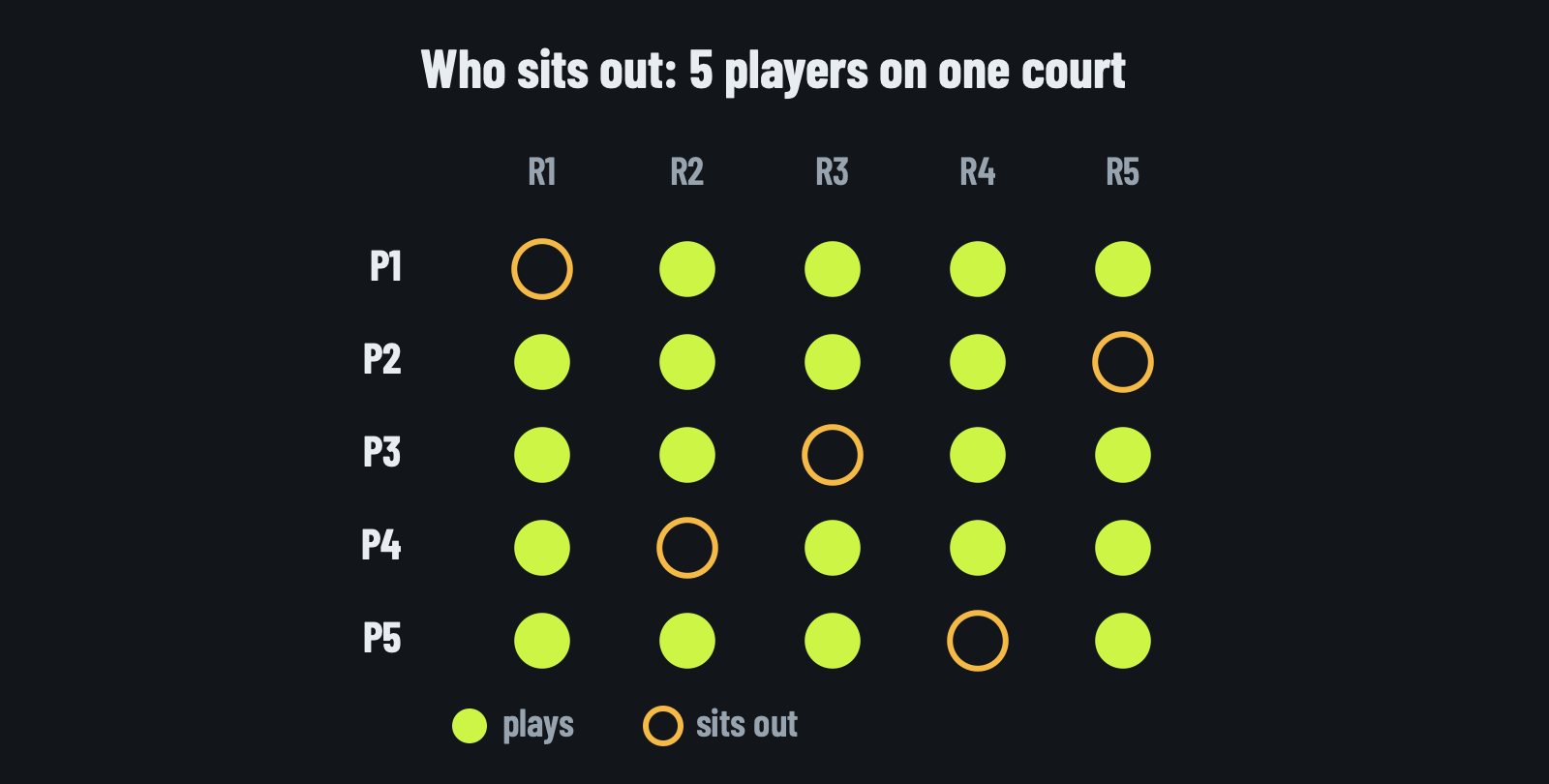
With 5 players on 1 court, one rests each round. Over 5 rounds everyone rests exactly once and partners every other player exactly once.
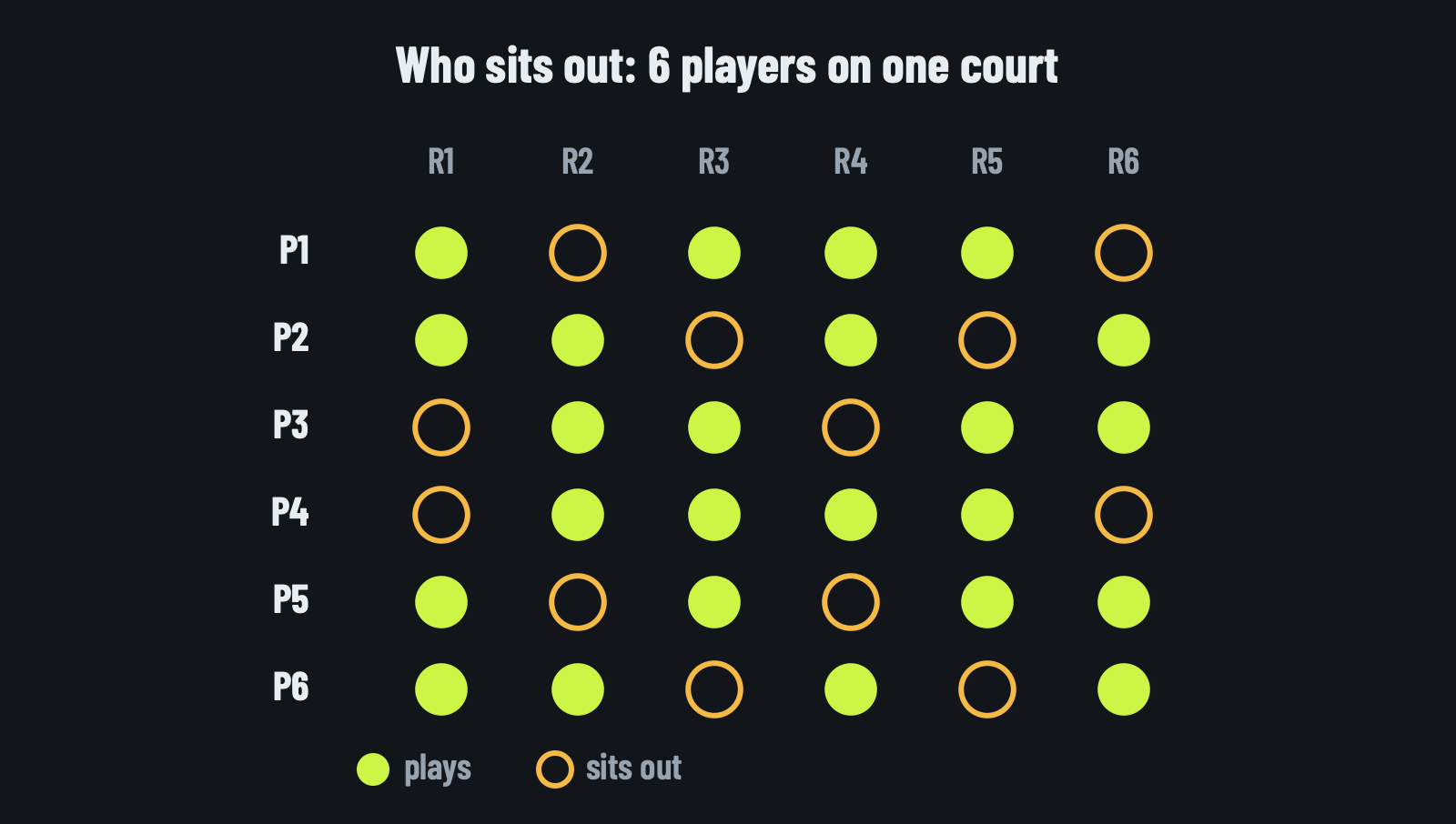
With 6 players on 1 court, two rest each round. Games even up every 3 rounds, so play 3 or 6 rounds.
What about other group sizes?
| Players | Sit out on 1 court | 2 courts | 3 courts | 4 courts | Games level out (most courts) | Every pair once |
|---|---|---|---|---|---|---|
| 5 | 1 | needs 8+ | needs 12+ | needs 16+ | every 5 rounds | yes, 5 rounds |
| 6 | 2 | needs 8+ | needs 12+ | needs 16+ | every 3 rounds | no |
| 7 | 3 | needs 8+ | needs 12+ | needs 16+ | every 7 rounds | no |
| 8 | 4 | 0 | needs 12+ | needs 16+ | every round | yes, 7 rounds |
| 9 | 5 | 1 | needs 12+ | needs 16+ | every 9 rounds | yes, 9 rounds |
| 10 | 6 | 2 | needs 12+ | needs 16+ | every 5 rounds | no |
| 11 | 7 | 3 | needs 12+ | needs 16+ | every 11 rounds | no |
| 12 | 8 | 4 | 0 | needs 16+ | every round | yes, 11 rounds |
| 13 | 9 | 5 | 1 | needs 16+ | every 13 rounds | yes, 13 rounds |
| 14 | 10 | 6 | 2 | needs 16+ | every 7 rounds | no |
| 15 | 11 | 7 | 3 | needs 16+ | every 5 rounds | no |
| 16 | 12 | 8 | 4 | 0 | every round | yes, 15 rounds |
For the full draw, open the page for your group: 5, 6, 7, 9, 10 or 11 players.
What about big groups on few courts?
With 9 or more players on one court, more players rest than play, so "never twice in a row" is impossible. A fair draw then rests whoever played last round first, and nobody waits much longer than anyone else. With 16 players on one court, that keeps the longest wait at four rounds, and the mix of players still changes every round.
Next: Team Americano, with fixed partners.
Questions people ask
Who should sit out in a padel Americano?
Whoever has played the most games so far, and never someone who sat out the round before. Rests should never depend on scores, so nobody is benched for losing.
How many players sit out with 9 or 10 players?
On two courts, 9 players means one sits out each round and 10 players means two. On one court, 9 players means five sit out each round.
Do players get points for sitting out?
That is your choice. The common options are nothing, half a match (12 points in a 24-point match), or the player's own average per match. Half a match means resting neither helps nor hurts.
Is it fair if some players sit out more than others?
Only by one. A fair schedule keeps everyone's games within one of each other at every point in the evening, and evens them out completely after a set number of rounds.
What happens with 16 players on one court?
Twelve players rest every round, so waits are long. A fair draw rests whoever just played and keeps the longest wait to four rounds.